
How to Connect Pax8
To configure and connect the Pax8 integration, please select from the following:
- Authenticate Pax8 with OAuth
- Map Accounts
- Map Services
- Arrears Billing
- Azure Via Pax8
- How to make a Pax8 company active
Troubleshooting
Authenticate Pax8 with OAuth
Good news: Pax8 is one of the easiest integrations to connect. There are no API keys to generate, you just log in. Here's how:
- From the left-hand navigation bar in Gradient, select Data Sources > Integrations.
- Scroll to Pax8, or search for it in the filter bar, and select Configure.
- In the window that opens, select the Authenticate
- You will be redirected to the Pax8 login portal. Sign in with your Pax8 Admin credentials and you'll be brought back to Gradient automatically.
- Once authenticated, Gradient will begin pulling in your accounts and services. If the integration status doesn't update right away, click the Status Refresh button or refresh your browser.
- Click Next to proceed to account mapping.
|
|
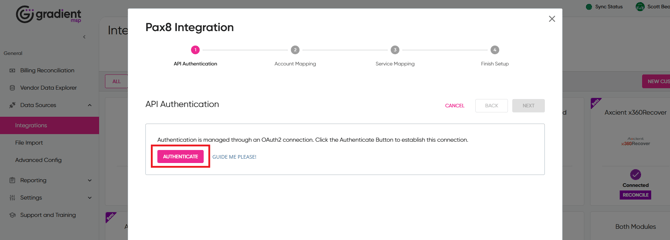
Note that the first time you press authenticate, it will take at least 5 minutes for the initial sync to run. During this time it will say the API Status is Not Ready.
Give this approximately 10-15 minutes and press the "Status Refresh" button. This will eventually show you all of the accounts and services as a number and you can press next.
If you don't want to wait on this screen, you can always come back to this step later while you connect other integrations.
Map Accounts
After authenticating, Gradient will show you a list of all the companies it found in your Pax8 portal. Your job here is to tell Gradient what each Pax8 company is called inside your PSA.
TIP: Gradient only pulls in companies that are marked as Active in Pax8. If a company you expect to see isn't showing up in the account mapping list, there's a good chance it's in an Inactive state in Pax8.
See the How to Make a Pax8 Company Active section below for details on how to fix this.
Arrears Billing
Certain Pax8 products (like Azure and some non-Microsoft products) are billed in arrears, meaning usage is calculated at the end of the month and the invoice reflects actual consumption rather than a fixed quantity. Gradient handles these, but there are two things you need to have in place first.
Step 1: Link your companies to their Resource Groups in Pax8
For arrears products, Pax8 needs to know which customers are associated with which subscriptions internally. This is done through Resource Group linking inside the Pax8 portal. If this step hasn't been done, Gradient will show a quantity of 1 for every customer regardless of their actual usage, because Pax8 isn't telling us who the usage belongs to.
Use Pax8's own guide to complete this step: How to Map Usage in Pax8
Heads up: After linking companies in Pax8, there is a short delay before the Pax8 API reflects the change. If Gradient still shows quantity 1 shortly after linking, wait a few minutes and run a fresh sync before assuming something is wrong.
Step 2: Map to the Arrears version of the service
When mapping arrears products in Gradient's service mapping, you must select the version of the service labeled "Arrears Charge" or "Arrears Billing" (the exact label depends on the product). These are distinct from the standard subscription versions. If you map to the non-arrears version, usage data will not populate correctly.
Top
Azure via Pax8
Azure is one of the more nuanced products to reconcile through Pax8 because it's billed in arrears based on actual consumption. Here's what to know:
- Gradient pulls Azure usage from the Pax8 invoice as it becomes available mid-month. If you check early in the month, you may see no data or a quantity of 1, this is expected while Pax8 is still generating your invoice.
- Make sure your Azure subscriptions are linked to the correct company inside Pax8 (see Resource Group linking above). Azure subscriptions in particular sometimes aren't linked by default if they were set up before you configured the Pax8 integration.
- When mapping Azure in Gradient, look for a product named something like Azure Plan Monthly Arrears and map to that version, not the standard Azure Plan Monthly product.
- Gradient reconciles by quantity, not price. For Azure, the usage figure from Pax8 (e.g., $68.76) will appear as a quantity in Gradient. If your PSA agreement uses a flat-rate pricing model for Azure, you may need to adjust your reconciliation approach accordingly, Gradient shows you what Pax8 says you're consuming, and it's up to you to decide how that maps to your billing structure.
Top
How to Make a Pax8 Company Active
If a company isn't showing up in Gradient's account mapping list, it's likely in an Inactive state in Pax8. Gradient only pulls Active companies.
When a new company is added to Pax8, it defaults to Inactive until the following contacts are assigned to it:
- One Billing contact
- One Technical contact
- One Admin contact
All three are required, but they can all be the same person. Once those contacts are in place, Pax8 will flip the company to Active and Gradient will be able to pull it in on the next sync.
Note: After making a company Active in Pax8, run a fresh sync in Gradient (via Sync Status > Quick Sync All) to pull in the newly active company. It won't appear automatically until the next scheduled sync otherwise.
Troubleshooting Topics
- Pax8 used to sync but is now showing an error and nothing has changed on your end
- A company I expect to see is not showing up in account mapping
- Arrears products are showing quantity 1 instead of actual usage
- I can see Azure in Pax8 but Gradient shows no usage or quantity 1
- Proofpoint via Pax8 isn't showing the right quantities
- Acronis purchased through Pax8 doesn't appear in the service list
Pax8 used to sync but is now showing an error and nothing has changed on your end
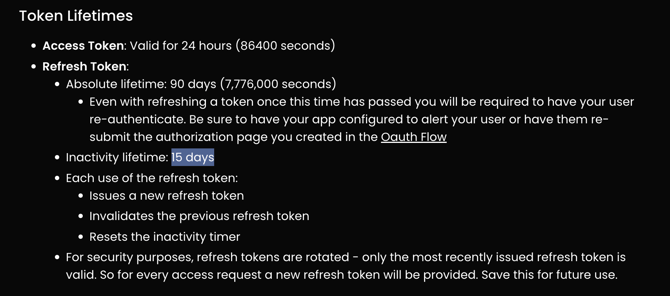
Pax8 OAuth tokens expire after 90 days. When this happens, Pax8 will stop syncing and show an error, even though your configuration is still correct. The fix is simple: head to Data Sources > Integrations > Pax8, hit Reconfigure Integration, and log in again. Run a fresh sync and you should be back in business.
|
|
A company I expect to see is not showing up in account mapping
This almost always means the company is Inactive in Pax8. See the How to Make a Pax8 Company Active section above. Once the required contacts are added, the company will become Active and appear on your next sync.
Arrears products are showing quantity 1 instead of actual usage
This means the company hasn't been linked to the correct Resource Group inside Pax8. Without this step, Pax8 doesn't associate usage with a specific customer, so Gradient receives a count of 1 regardless of actual consumption. Complete the Resource Group linking steps in Pax8, then wait a few minutes and run a fresh sync.
I can see Azure in Pax8 but Gradient shows no usage or quantity 1
Check the following in order:
- Confirm that the Azure subscription is linked to the correct company in Pax8 (Resource Group linking).
- Confirm you are mapping to the Arrears version of the Azure product in Gradient's service mapping, not the standard version.
- If it's early in the month, the Pax8 invoice may not have been generated yet. Arrears data typically becomes available mid-month. Try again after the 5th to 7th of the month.
- If all of the above look correct and data still isn't appearing, contact support so we can take a closer look at the sync logs.
Proofpoint via Pax8 isn't showing the right quantities
Proofpoint can be tricky when purchased through Pax8. If you're consistently seeing incorrect counts or no counts at all, consider connecting the native Proofpoint integration instead of reconciling through Pax8. The native integration pulls directly from Proofpoint and tends to be more reliable. Keep in mind that the native integration will show your Proofpoint quantities but won't mirror what appears on your Pax8 invoice specifically.
Acronis purchased through Pax8 doesn't appear in the service list
In some cases, Acronis products purchased via Pax8 don't surface in Gradient's service mapping list. If you're not seeing Acronis in the list, reach out to support@meetgradient.com and we can investigate whether Pax8 is exposing that product through their API for your account.
Top
Still stuck? Reach out at support@meetgradient.com and we'll get you sorted. 🦩